) features six compositions, all with a deeply ingrained sense of place.
With an artist as wide-ranging and prolific as Xiu Xiu‘s Jamie Stewart, it can be hard to put into words what, exactly, his music sounds like. But when it comes to Stewart’s forthcoming NINA, he certainly doesn’t sound like himself.
Following its re-activation in January 2013 with releases that included projects by Bill Frisell, Bob James & David Sanborn, Michel Camilo and John Medeski, SONY Masterworks‘ OKeh Records is proud to announce their next wave of signings. The artists, who are part of the label’s “The Sound of Next” campaign are: saxophonist Craig Handy, Tunisian oudist/vocalist Dhafer Youssef, guitarist Nir Felder, drummer Jeff Ballard, saxophonist James Brandon Lewis, African vocalist Somi, and trumpeter Theo Croker.
“Each label, and OKeh is no exception, needs a good balance of established artists and newcomers to reflect what is happening in the world of music today,” states Wulf Müller, who oversees A&R for OKeh Records and ideated the re-launch in a recent news release. “The second phase of the re-launch is to focus on great new artists with different backgrounds and different takes on what jazz can be, but they all have one thing in common – they are part of Global Expressions in Jazz.”
To showcase the label’s new talent in “The Sound of Next” campaign, OKeh will release a seven-track “The Sound of Next” sampler featuring one song from each of these artists.
“The first wave of OKeh presented well-known masters of the jazz arts: John Medeski, Bob James and David Sanborn, Michel Camilo, and Bill Frisell,” explains Chuck Mitchell, senior vice president at Sony Masterworks U.S. “Now comes ‘The Sound Of Next’ – fresh expressions by established voices: Craig Handy’s 2nd Line Smith and Jeff Ballard’s Trio. And new dimensions opened by new voices: Somi, James Brandon Lewis, Dhafer Youssef, Theo Croker, and Nir Felder. ‘The Sound Of Next’ is a divining rod, a no-risk device to discover great global expressions in jazz, a midst the daily noise. For OKeh, ‘The Sound of Next’ is also ‘The Sound of Now.'”
Saxophonist-composer-producer-
As Watson reflects, Check Cashing Day serves as “a commentary on where we’ve been, where we are, and where we need to go as a people, as a country, and as a global community.” Instead of focusing on the iconic “I Have A Dream” aspect of Dr. King’s speech, Watson chose to concentrate on another very significant part: the reason why over 300,000 people, black and white, gathered in Washington, D.C., on Aug. 28, 1963. Dr. King spoke of coming to Washington to cash a 100-year-old check, a moral check that the founding fathers wrote into the Declaration of Independence, but to this day, the check keeps coming back marked ‘insufficient funds.’ “This, being the year of my 60th birthday, I sadly understand that Dr. King’s dream has not been fully realized and the struggle continues,” says Watson in a news release.
Introducing poet and spoken word artist Glenn North from Kansas City, Mo, Check Cashing Day is a concept recording with 15 tracks portrayed in the vein of musical theatre. “I asked Glenn to put some poetry, from his perspective, to several of my compositions, as well as one written by vocalist Pamela Baskin-Watson and two by bassist Curtis Lundy,” Watson says. “It was my desire with this project to produce poetry that would in some ways cleanse the soul,” North says. In addition, Watson’s release features trumpeter Hermon Mehari, pianist Richard Johnson, drummer Eric Kennedy, flutist Horace Washington, and trombonist Karita Carter.
With Watson’s commentary on the ongoing struggle of today’s racial inequalities spotlighted on compositions such as the title track “Check Cashing Day (For Ms. Trudy)” and “MLK on Jazz (Love Transforms),” he offers a recording that provokes positive conversation and continued movement towards Dr. King’s ‘dream,’ so that the ‘dream’ becomes a reality in today’s world. “The result is something more powerful and thought provoking than I could have imagined,” reflects Watson.
2013 promises to be a banner year for Watson, reuniting with his critically acclaimed Horizon quintet for their 30th anniversary as well as celebrating his own 60th birthday. Boasting a top-notch resume that ranges from his tenure as a member of Art Blakey’s JazzMessengers (eventually becoming musical director) to co-founding Horizon with drummer Victor Lewis as an acoustic quintet modeled after the Jazz Messengers, Watson plans to tour in 2014 with Horizon for their seminal anniversary. Watson will also tour with his “I Have a Dream” project in 2014 and is planning several release performances (to be announced).

OKeh announces a 12-city North American tour for Bill Frisell‘s Big Sur Quintet (Nov. 6, 2013, through Jan. 23, 2014). The tour is in support of his new album, Big Sur, and will feature violinist Jenny Scheinman, violist Eyvind Kang, cellist Hank Roberts and drummer Rudy Royston (who are all featured on the album as well).

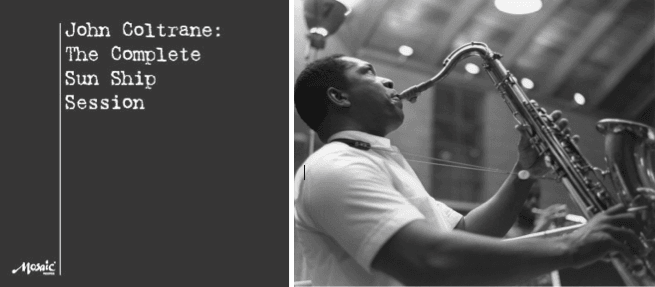
According to a recent news release, Mosaic Records is set to release The Complete Sun Ship Session which includes newly discovered and previously unissued alternate takes from one of the final studio sessions by the John Coltrane Quartet. The three LP set will be released August 6 and was also made available on a two-disc set through Verve Records on April 16.
Sun Ship, recorded Aug. 26, 1965, captures one of the last sessions by the Classic John Coltrane Quartet (Coltrane, pianist McCoy Tyner, bassist Jimmy Garrison and drummer Elvin Jones). It comes at the culmination of a year in which Coltrane arguably reached his creative peak, a year rich in such masterworks. The Sun Ship album, though, was not issued until 1971, one of several Coltrane albums issued by Impulse Records after his death. And Sun Ship was, like many jazz albums, the product of editing between takes, a process overseen by John’s widow Alice.
John Coltrane‘s Sun Ship session was recorded at the RCA Recording studio on 24th Street by engineer Bob Simpson who also did superb work with Sonny Rollins, Charles Mingus, Albert Ayler and others. The original three-track masters with the tenor sax on one track, the piano and bass on another and the drums on the third track were recently discovered, enabling the complete session to be released for the first time. Kevin Reeves remixed the entire session from the original three-track masters with great sonic results, improving greatly on the original LP mix. Mosaic has remastered them and pressed them on 180-gram vinyl at the renowned Record Technology Inc. plant in Camarillo, Calif.
This limited edition set is available exclusively from Mosaic Records.
http://www.youtube.com/watch?v=llg-zMRXnA8

Pianist, composer and Guggenheim fellow Myra Melford realizes two long-cherished dreams on her beautiful new release, Life Carries Me This Way (Firehouse 12). The album is both Melford’s first solo piano recording and a tribute to her friend, the late California visual artist Don Reich. Each of the eleven tracks was directly inspired by one of Reich’s rich, colorful canvases, brought to vivid sonic life by Melford’s deeply spiritual and personal compositions.
In the artist’s work, Melford found a range of artistic expression equal to the diversity and vibrancy of her own broad palette of invention. “Don takes a wide range of approaches to painting, from very abstract to almost cartoonish,” she explains in a news release. “Seeing his paintings made me want to play the piano, and his very wide range from abstracts to landscapes to still lifes allowed me to cover a range of my own playing from dense, polytonal, high-energy work to very simple, beautiful melodies. I felt like there was room for all of that in the scope of his artwork.”
Reich, who passed away in 2010 after suggesting a number of artworks for Melford’s interpretation, was a longtime friend of the pianist’s family. It was that closeness that led Melford to choose his work as the basis for her long-awaited solo debut. “There’s something so immediate and personal about any kind of solo,” Melford says. “But particularly for me to play solo piano, I’m completely exposed, I’m not covered up by the orchestration or by other people playing. So that seemed to be the best way for me to communicate personally how I feel about Don’s artwork. There’s no one else to interpret it but me.”
Such personal connections were vital to Melford’s approach to writing this music. Reich’s paintings “Barcelona” and “Sagrada Familia” immediately summoned memories of Melford’s own visits to the Spanish city and its landmark Gaudí-designed church. “My experience in those places was overlaid against stories that Don had told me about being there,” Melford says. “So there were several levels of information that went into informing how the music came about for each piece.”
Most important, perhaps, was Melford’s friendship with the artist, whose personality is laced throughout her meditations on his work. “Don was a really quirky, unique individual and a very joyful person,” she recalls. “He took great pleasure in life and was a really keen observer. He was very sense-oriented, so that also informed my perception and my response to his paintings.”
Typically for Melford, who has drawn inspiration from a number of spiritual, musical and artistic traditions throughout her career, Life Carries Me This Way is a solo album that is still something of a collaborative effort. “Another way to describe that would be a sense of connectedness,” she suggests. “Nothing really exists in a vacuum, and of course all of these connections that are important to me are part of how I express myself as an artist.”
Raised in a Frank Lloyd Wright-designed house, Melford grew up literally surrounded by art, and has since crafted a singular sound world that harmonizes the intricate and the expressive, the meditative and the assertive, the cerebral and the playful. She draws inspiration from a vast spectrum of traditions and disciplines, from the writings of Persian poet Rumi and the Uruguayan journalist Eduardo Galeano to the wisdom of Zen Buddhism and the Huichol Indians of Mexico, to the music of mentors like Jaki Byard, Don Pullen, and Henry Threadgill.
Melford’s palette expands from the piano to the harmonium and electronic keyboards or to amplifying barely audible sounds in the piano’s interior. Her playing can build from the blissful and lyrical to the intense and angular. In 2013, she was named a Guggenheim Fellow and received both the Doris Duke Charitable Foundation’s Performing Artist Award and a Doris Duke Residency to Build Demand for the Arts at San Francisco’s Yerba Buena Center for the Arts. She was also the winner of the 2012 Alpert Award in the Arts for Music and has been honored numerous times in DownBeat’s Critics Poll since 1991.
Marc Cary has gained a reputation as one of the most creative pianists of our time, a bandleader with musical interests that encompass jazz, go-go, hip-hop, electronic music, Indian classical music and more. But Cary is also an incisive and sought-after accompanist, a fact famously borne out by his 12-year tenure (beginning in 1994) with the great vocalist, songwriter and jazz icon Abbey Lincoln.
For the Love of Abbey (Motema Music), Cary’s first solo piano recording, is the most personal and heartfelt of tributes, shedding light on Lincoln’s remarkable body of work and honoring her extraordinary gift for melody and song craft.
“Abbey’s compositions are worthy of an instrumental approach because they’re so rich and lend themselves to be interpreted as instrumentals,” says Cary in a news release.
Cary’s tenure with Lincoln was longer than that of any other pianist. And Cary was following in the footsteps of the very best: Mal Waldron, Hank Jones, Wynton Kelly and Kenny Barron, among others.
“I try not to freak myself out by saying, ‘Wow, now I’m the one,'” Cary reflects. “It made me feel good but it didn’t influence me in any way, because Abbey wanted something new, something in the moment.”
Even when paring down to solo piano on For the Love of Abbey, Cary makes music of great orchestrational variety and depth. Still, he heeds the wisdom of Lincoln herself, who would often admonish him with the words: “It’s a simple song.” As Cary says, “With Abbey I had to play differently than I did. It changed my whole perspective. I learned how to deconstruct myself.”
Asked for the single most valuable lesson he got from Abbey Lincoln, Cary responds: “Learning how to shed things you don’t need, and claim what is yours.”
http://youtu.be/LLd6lW-ZXzU
Justin Time Records is proud to release vocalist Alex Pangman‘s new album, Have a Little Fun (available tomorrow, June 11). The album features legendary guitarist Bucky Pizzarelli, and is Pangman’s second release for the Canadian music label.