Recently, I had the experience of trying the new Soft Scrub Total All Purpose Bath & Kitchen Cleaner. No only has the formula improved, but the product is in a new bottle design and has a new cap for better dispensing.
This cleaner is tough on stains, yet gentle on surfaces. It is certainly better for cleaning and rinsing for tile, grout, sinks and tubs. In addition, Soft Scrub® is proud to introduce the One Surface at A Time® Sweepstakes featuring Soft Scrub® Total All Purpose!
One lucky grand prize winner will receive $1,000 and a year’s supply of Soft Scrub, while 250 second place winners will receive free Soft Scrub. For more information, click here.
It has been 15 years since bassist Kyle Eastwood burst onto the jazz scene with his 1998 debut, From There to Here. At that moment in his budding career, the press seemed more preoccupied with his paternal lineage (he’s the son of famed actor-director Clint Eastwood) than his music. Over the course of the four subsequent releases – 2004’s Paris Blue, 2005’s Now, 2009’s Metropolitan and 2011’s Songs from the Chateau – Eastwood built up an impressive body of work while earning respect in musician circles. With his sixth release as a leader, The View from Here on the JazzVillage label, he demonstrates a strong command of both electric and upright basses while expanding into more adventurous territory that is informed as much by jazz as it is by world music.
“I’ve always loved music from other countries,” says the Carmel, California native who has resided in Paris for the past eight years in a news release. “Living in France, you hear a lot of North African and Middle Eastern music, and you can hear some of those influences on this new recording.”
Accompanied by a London-based crew of stellar young musicians worthy of wide recognition — pianist Andrew McCormack, tenor saxophonist Graeme Blevins, trumpeter Quentin Collins and drummer Martyn Kaine — Eastwood and company blend infectious grooves and outstanding improvisations throughout eleven diverse tracks on The View from Here.
“They’re all really talented players,” says Eastwood, “and we’ve been playing together for a while now, developing a real band chemistry. We ended up writing a lot of these new tunes together either at rehearsals or out on the road during last year’s tour around Europe. Sometimes I would come up with a couple of ideas or Andrew might bring something in, then everybody would just add on to it after that.”
In addition to his six solo albums, Eastwood has also contributed music to eight of his father’s films: The Rookie (1990), Mystic River (2002), Million Dollar Baby (2004), Flags of our Fathers (2006), Letters from Iwo Jima (2006), Changeling (2008), Gran Torino (2008) and Invictus (2009). And while he takes pride in those credits, his most personal, fully realized and rewarding project to date is his current quintet offering, The View from Here.
On her new album, Glass Song, Moscow-born pianist/composer Yelena Eckemoff celebrates the season of renewal that ushers winter into spring with a mesmerizing set of crystalline beauty, available on L & H Production. In crafting this, the latest expression of her gorgeously delicate blend of classical intricacy and jazz invention, Eckemoff brings together two of modern music’s greatest improvisers for the first time: bassist Arild Andersen and drummer Peter Erskine.
Eckemoff herself is no stranger to rebirth. Classically trained, she has successfully transitioned into a strikingly assured jazz composer; raised in the Soviet Union, she fled her repressive homeland and has lived in the United States for the past two decades. Her evocations on spring’s rejuvenating thaw vividly illustrate her life experiences, as she hints in her liner notes.
“The same way as spring is always certain to replace even the most severe winter,” she writes, “hope is eternally present in the least favorable situations and in all circumstances of life.”
Eckemoff frequently turns to images of nature when composing, from the wintry landscapes of Cold Sun to the serene breezes of Grass Catching the Wind. But as she explains, the seasons suggest the constant change and evolution in life, which is even more important to her music. “I get inspired by nature a lot, because everything comes from nature,” she says in a news release. “But the observation of nature isn’t really my priority. I’ve had very, very rich experiences in my life, and the music I write expresses those feelings.”
Glass Song conjures images of sun glinting off of ice and frost melting away from windowpanes. It is also quite literal on the title track, which begins with the sound of Eckemoff playing water-filled glasses. But those concepts are equally present in the airy chill that opens the first track, “Melting Ice,” or in the shimmering rhythms of “Dripping Icicles.”
The trio that Eckemoff has assembled to help realize these reflective visions is composed of two of jazz’s most creative minds – who remarkably had not worked together prior to this recording. The legendary Erskine played with Weather Report and Steps Ahead in the early years of a career that has now spanned four decades and includes recordings and performances with everyone from Steely Dan to John Abercrombie, Joni Mitchell to Gary Burton and Pat Metheny. Norwegian bassist, Andersen, has an equally impressive resume, encompassing a six-year stint in the Jan Garbarek Quartet and more than a dozen albums as a leader for ECM.
Erskine had worked with Eckemoff on two earlier CDs, but the pianist had been searching for an opportunity to work with Andersen for a number of years, and Glass Song provided the perfect collection of material. “I was really excited about having the opportunity to put together those two giants for the first time,” Eckemoff says.
The combination works spectacularly, three distinctive voices seeming to breathe as one. The sensitivity of Erskine and Andersen serves Eckemoff’s fragile compositions with an airy but sure touch. The lush serenity of the leader’s piano is matched by the singing caress of Andersen’s bass and the hushed precision of Erskine’s percussion. The trio shares a deep intimacy while remaining attuned to the spaciousness of the pieces, all captured in the wondrously lush sound of the recording.
Eckemoff herself began playing piano at the age of four, studying first with her mother Olga, a professional pianist, then at the prestigious Gnessins Academy of Music and the Moscow State Conservatory. Despite the repressive atmosphere in the Soviet Union at the time, she began to explore rock and jazz music with other like-minded musicians. “Everything from the west was prohibited at that time,” she recalls, “and jazz was one of those things. But there was a jazz studio formed by some activists who were also professional musicians and we studied traditional jazz. I used jazz principles in my composing, which put me on a different path from other musicians.”
Eckemoff stepped away from her life as a concert pianist for several years to concentrate on raising her children. She finally left the Soviet Union with her husband, momentarily leaving her three children behind. “That was the hardest thing I ever did,” she says, “but we had the drive to leave Russia. It was a very hard and scary thing to do, but it worked out and we never regretted it. It ended up helping me in my musical development because I had much deeper spiritual experiences because of it.”
That sense of spiritual comes vividly to life in pieces like the sun-dappled “Sunny Day in the Woods” or the tender, evanescent “Sweet Dreams.” While the titles are accurate depictions, they’re almost unnecessary given the illustrative, purely emotional music itself. Once resettled in the States, Eckemoff returned to recording, taking advantage of modern recording techniques. Since then she has been stunningly prolific, first with classically oriented recordings and then with her reinvention as an elegant jazz musician in the past several years.
“Some people dance, some people sing, some people write,” Eckemoff explains. “When I feel something, I compose. It’s almost like I can’t stop it. My head is always filled with music. If I couldn’t write music I think I would just explode. Life is sometimes sad, but I find escape in writing music. I’m happy because I can do it.”
Eight years after his brother’s untimely death, guitarist and composer Bill Horvitz pays homage to Philip with his latest release, The Long Walk, set for national release, April 2. Special tribute performances are being planned for the San Francisco Bay Area (March) as well as New York (June).
The Long Walk is a suite of eight pieces composed by Bill Horvitz for the 17-piece Bill Horvitz Expanded Band as a tribute to his youngest brother Philip Horvitz, who passed away suddenly of a heart failure in 2005 at the age of 44. Philip was an inspired writer, director, actor, dancer, and choreographer, who worked primarily in San Francisco and New York. The music includes a wide range of styles drawing on jazz, funk, folk, and new music. The compositions are tightly composed and arranged and contain sections of conducted improvisation. Each piece relates in some way to a part of Philip’s life.
After Philip died, Horvitz wanted to compose music as a tribute to him, and about a year after his death, began hearing the beginnings of new compositions that felt in different ways related to Philip’s life. As Horvitz worked tirelessly on his compositions, the music evolved and he began adding instruments. The resulting pieces are a collection of jazz, rock, folk, classical, and funk-influenced works that have come out of the enormous range of emotions Horvitz has felt since his brother’s untimely death.
“I did not compose this music with literal ideas about Philip in mind, but found elements that related to him as each piece grew,” Horvitz said in a news release. For example, “Child Star” with all the appropriate fanfares, refers to a time very early in Philip’s life when he often performed for his family, “Philip would create theatrical pieces, command performances based on Broadway musicals, for which he printed and sold tickets. He would dance in the living room and lip sync or sing along with recordings, all highly choreographed and rehearsed to a tee.”
Bill Horvitz has spent nearly 40 years combining composition and improvisation and expanding the voice of the guitar in both large and small ensembles. Between 1978 and 1988, he lived and worked in New York City, where he worked with a long list of composers and musicians. Horvitz’ lengthy and varied experience in the realms of jazz, rock, classical, folk, and new music have resulted in an entirely original compositional voice-a voice that is forceful and innovative, yet always intelligently accessible. As a guitarist, Horvitz stretches the boundaries of guitar music and points it in new and exciting directions. He fuses traditional and extended techniques in a most inventive way; his strikingly personal instrumental vision endows his music with an infinite array of tonal color.
In addition to leading and playing in The Bill Horvitz Expanded Band, since 2004, he has sung and played guitar, banjo, and ukulele with TONE BENT, a folk duo with his wife, composer, musician and singer Robin Eschner. Their first release, Say What You Will, has been described as “a roaring ride through the heartland of human experience.” They’re second release Angels In the Kitchen will be released in the spring of 2013. Horvitz also leads and composes for the instrumental trio, The Skerries, with bassist Scott Walton and drummer Tom Hayashi. He is a founding member of Take Jack, a nine-member vocal and instrumental band and has composed music for theater, film, dance, art installation, and spoken word.
Funeral services have been confirmed for Cleotha ‘Cleedi’ Staples (a founding member of the pioneering folk-gospel group, The Staple Singers), who died of complications of Alzheimer’s disease, on Feb. 21, 2013.
“We will keep on,” Mavis Staples says of her sisters’ death in a news release. “Yvonne and I will continue singing to keep our father’s legacy and our sister’s legacy alive. I just finished my second record with Jeff Tweedy, and it will be dedicated to my dear Cleedi’s memory.”
The viewing takes place at 6 p.m. Thursday Feb. 28 at Leak & Sons Funeral Home, 7838 South Cottage Grove, Chicago. The funeral service takes place at 10 a.m. Friday March 1 at Trinity United Church of Christ, 400 W 95th Street, Chicago. The burial will follow at Oakwood Cemetery. Ms. Staples will be buried in the Staples family plot alongside her father, Roebuck “Pops” Staples; her mother, Oceola Staples; and her sister, Cynthia Staples.
The Staple Singers burst on the national scene in 1956 with the Vee Jay Records hit “If I Could Hear My Mother Pray Again.” With Pops’ blues-influenced guitar, Cleotha’s bright high notes, Pervis’ falsetto and Mavis rich contralto, they were on their way to stardom. They became one of the biggest gospel outfits of the era and turned out best-selling gospel classics such as “On My Way to Heaven,” “Will The Circle Be Unbroken,” “Don’t Knock,” “Pray On” and their signature hit, “Uncloudy Day,” generally accepted to be the first gospel record to sell one million copies.
In the ’60s, the group began to record inspirational mainstream music such as “For What It’s Worth” and “Why? (Am I Treated So Bad).” By 1968, they had moved on to Stax records where they enjoyed a steady run of Top 40 hits like “Heavy Makes You Happy (Sha-Na-Boom Boom Yeah)” and “Touch a Hand, Make a Friend” (1974). The iconic million-seller “I’ll Take You There” spent a week at No. 1 on the Billboard pop singles chart and four weeks at that spot on the R&B singles chart. The group also earned other million-sellers such as “Respect Yourself” (1971), “If You’re Ready (Come Go With Me)” (1973) and “Let’s Do It Again” (1975). The Staple Singers were inducted into the Rock and Roll Hall of Fame in 1999 and they also received a Grammy Lifetime Achievement Award in 2005. Cleotha is survived by her siblings Pervis, Yvonne and Mavis; her dedicated caretakers Penny and Sushi; and a loving and wonderful extended family of nieces, nephews and treasured friends.
Terri Lyne Carrington. Photo Credit: Annette Brown
In 1962, Duke Ellington recorded a trio date with bassist Charlie Mingus and drummer Max Roach that is today considered one of the pivotal jazz recordings of the 1960s. Money Jungle, the 1963 album that emerged from the session, was – among other things – a commentary on the perennial tug-of-war between art and commerce. In some ways, the album’s 11 tracks were intended as a sort of counterbalance to the capitalist bent of the Mad Men generation.
Fifty years later, this precarious balance in the world of jazz – or in any art form, for that matter – hasn’t changed much. Enter Grammy Award-winning drummer, composer and bandleader Terri Lyne Carrington, who enlists the aid of two high-profile collaborators – keyboardist Gerald Clayton and bassist Christian McBride – to pay tribute to Duke, his trio and his creative vision with a cover of this historic recording. Carrington’s Money Jungle: Provocative in Blue was released by Concord Jazz on Feb. 5, 2013.
Duke’s original recording is something that has haunted Carrington since she first heard it about a decade ago. “I had bought it on CD, from the discount bin in a music store,” she says in a news release. “I put it on in my car, and I immediately just felt something mysterious about it. There was just an energy that moved through the tracks. Duke and Charles and Max had a chemistry about them. There was this tension that you could hear, and yet they fit together like a hand in a glove.”
In preparation for the project, Carrington read up on Duke’s biography. “I felt like a method actor, she says. “I just dug as deep as I could in the time that I had to get a glimpse of his perspective on things. When you start rearranging music by someone like Duke Ellington, you better feel really good about what you’re doing. In the end, I felt confident that I didn’t do him a disservice, because he was a very open-minded artist, and he was very much about moving forward.”
Carrington considers her Money Jungle – like its predecessor – primarily a trio album, but she’s not averse to some enhancement and additional textures along the way. Helping out with the rearrangements and reinterpretations is an impressive list of guest artists: trumpeter Clark Terry, trombonist Robin Eubanks, reed players Tia Fuller and Antonio Hart, guitarist Nir Felder, percussionist Arturo Stabile and vocalists Shea Rose and Lizz Wright. Herbie Hancock appears in a spoken word segment as the voice of Duke Ellington.
The music of Duke’s Money Jungle may have first emerged a half-century ago, but “there’s nothing old about great music and great musicians,” says Carrington, who sees her own Money Jungle: Provocative in Blue as addressing some of the same issues as its 1963 predecessor. “There’s always something that’s new, if you know how to listen to it. You have to be able to appreciate the past if you want to have a future. I think that’s a big part of our job as artists and entertainers and educators – to keep reminding the younger musicians how important our predecessors were – especially the people who made the music what it is today. So it was my goal to bring some fresh light and fresh energy to some of Duke’s music in general and this recording in particular.”
Left to right: Cleotha, Yvonne and Mavis Staples. Roebuck “Pops” Staples is seated. Photo Provided – 1984.
According to a recent news release, Cleotha ‘Cleedi’ Staples, a founding member of the pioneering folk-gospel group, The Staple Singers, has died at age 78. She had battled Alzheimer’s disease for the last decade and passed away peacefully at her Chicago home on Feb. 21, 2013.
Staples was born April 11, 1934 in Drew, Mississippi. She was the first-born child of Roebuck “Pops” Staples and his wife, Oceola. The family moved to Chicago in 1936 for better job opportunities. In the Windy City, siblings Pervis, Yvonne, Mavis and Cynthia were born. Pops worked a variety of manual labor jobs during the day, and Oceola worked at the Morrison Hotel at night. To entertain the children in the evening, Pops began to teach them gospel songs while he strummed along on his $10 guitar. His sister Katie enjoyed the sing-a-longs so much that she arranged for the family to sing at her church one Sunday morning in 1948. The family was called out for three encores and more than $7 was raised in the offering basket. Pops realized the family group had a future, and The Staple Singers were born.
The group began to sing on WTAQ 1360 AM radio and made its first recording with “These Are They” for Pops’ own Royal Records in 1953. They then recorded for United Records before striking gold with Vee Jay Records where they recorded “If I Could Hear My Mother Pray Again” in 1956. With Pops’ blues-influenced guitar, Cleotha’s bright high notes, Pervis’ falsetto and Mavis rich contralto, they were on their way to stardom. They became one of the biggest gospel outfits of the era and turned out best-selling gospel classics such as “On My Way to Heaven,” “Will The Circle Be Unbroken,” “Don’t Knock,” “Pray On” and their signature hit, “Uncloudy Day,” generally accepted to be the first gospel record to sell one million copies.
The family became active in the Civil Rights movement after hearing Dr. Martin Luther King Jr. preach at Dexter Avenue Baptist Church in Montgomery, AL in 1962 while on tour, and they often performed at events at the request of Dr. King. As they became immersed in the Movement, their music broadened from gospel music to more mainstream material. In 1963 they became the first black recording artists to cover a Bob Dylan song (“Blowin’ in the Wind”), and they also recorded songs of protest such as “For What It’s Worth,” “Freedom Highway” and “Why? (Am I Treated So Bad).” By 1968, when Pervis had left the group for the Army, and Yvonne Staples took his place, they began to record for Stax Records, home of southern soul stars such as Otis Redding, Booker T. & The MGs and Sam & Dave.
At Stax, the Staples enjoyed a run of Top 40 hits, becoming known as “God’s greatest hitmakers” with such songs as “Heavy Makes You Happy (Sha-Na-Boom Boom Yeah)” (1971), “This World” (1972), “Oh La De Da” (1973), “Touch a Hand, Make a Friend” (1974) and “City in the Sky” (1974). The iconic million-seller “I’ll Take You There” spent a week at No. 1 on the Billboard pop singles chart and four weeks at that spot on the R&B singles chart. The group also earned two other million-sellers at Stax with “Respect Yourself” (1971) and “If You’re Ready (Come Go With Me)” (1973).
Although Pops and Mavis usually handled vocal leads on Staple Singers songs, Cleotha was featured with Eddie Floyd (of “Knock on Wood” fame) on “It’s Too Late” from the 1969 Stax Records duets LP Boy Meets Girl. Her velvety soprano was powerful and dynamic on the bluesy ballad about a lost love. She also appeared with her family’s group in Ghana in 1971 at the Soul To Soul concert, appearing along with Wilson Pickett, Ike & Tina Turner and Santana; at the historic 1972 Wattstax festival in Los Angeles and in Martin Scorsese’s landmark 1978 concert film “The Last Waltz,” in which Ms. Staples and her family sang “The Weight” with The Band. The Soul To Soul concert and the Wattstax Festival, known as “the Black Woodstock,” have both been the subject of recent documentaries.
The Staple Singers moved to Curtis Mayfield’s Curtom label in the mid-1970’s, where they scored another No. 1 smash, “Let’s Do It Again,” in December 1975 before signing with Warner Bros. Records.
Cleotha’s last recordings were with the Staple Singers for backing sessions on Abbey Lincoln’s Devil Got Your Tongue CD (1993) and Pops Staples’ two solo albums, Peace to the Neighborhood (1992) and the GRAMMY Award-winning Father Father (1994). After Pops died in 2000, the Staple Singers ceased to perform as a group.
Ms. Staples was inducted into the Rock and Roll Hall of Fame with her family in 1999 and also received a Grammy Lifetime Achievement Award in 2005.
Cleotha is survived by her siblings Pervis, Yvonne and Mavis, her dedicated caretakers Penny and Sushi, and a loving and wonderful extended family of nieces, nephews and treasured friends.
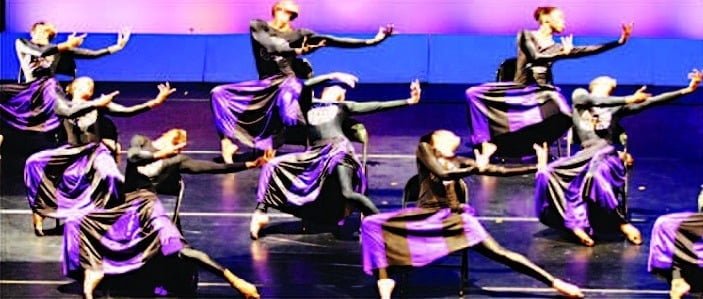
According to a recent news release, Black Liberated Arts Center Inc. (BLAC Inc.) will present the Cleo Parker Robinson Dance Ensemble at 8 p.m. on Saturday, Feb. 23 at the Frederick A. Douglass High School Auditorium, 900 N. Martin L. King Jr. in Oklahoma City. The 40-year-old Denver-based company, in the middle of its Spring tour, will travel to Crested Butte, Colo., and Seattle, Wash., before the Oklahoma City appearance.
Led by its founder, executive director and choreographer Cleo Parker Robinson, the company has performed in Iceland, Singapore, Hawaii, Nassau, Belize, Israel, Egypt, Turkey and throughout Europe and Africa. Parker Robinson holds an honorary doctorate degree from Denver University (1991), an honorary doctorate of Humane Letters from Colorado College (2003) and an honorary doctorate of Public Service from Regis University, Denver (2008).
In 1998, President Clinton named Parker Robinson as one of two artists to be appointed to the National Council on the Arts in Washington, D.C., where she served until 2005. She received a Kennedy Center Medal of Honor during the center’s “Master of African American Choreographers” series.
The dance ensemble will arrive on Feb. 20 and will work with Oklahoma City fourth-, fifth- and sixth-graders from several area schools. Selected students will perform a welcome dance at Douglass on the same stage as the Cleo Parker Robinson Dance Ensemble.
This performance is made possible by the MetLife Community Connections Fund of the New England Foundation for the Arts’ National Dance Project. Major support for the National Dance Project is also provided by the Doris Duke Charitable Foundation with additional support from the Andrew W. Mellon Foundation. Local support is provided by the Oklahoma Arts Council and the Ad Astra Foundation.
Tickets for the performance are on sale at Learning Tree Toys, Charlie’s Jazz, Rhythm & Blues Store and Hopkins HairCare at $20 general admission. VIP tickets that include reserved seats and a reception are $50 and can be purchased at BLAC Inc. offices using MasterCard, Visa, checks or cash. Discount tickets are offered at BLAC Inc. For more information, call (405) 524-3800.
John Hollenbeck didn’t seek out popular music when he was kid, but it was always there, and it became an undeniable part of him. Songs I Like a Lot(to be released Jan. 29 on Sunnyside Records) is an album on which the adventurous and internationally renowned composer, esteemed for his ability to strike upon new sounds, turns instead toward familiar forms, and weaves other peoples’ songs into his own unique tapestry.
Growing up in Binghamton, New York, Hollenbeck frequently heard “Wichita Lineman,” a song originally by pop writer Jimmy Webb, as sung by one of his father’s favorite pop balladeers Glen Campbell. Although he was more interested in music that sounded new to him, Webb’s songwriting left an indelible impression. For Songs I Like a Lot, Hollenbeck scoured his memory in search of songs that had similarly become inextricable from his musical outlook. He compiled a big list, and whittled it down with help from vocalists Theo Bleckmann and Kate McGarry, who are featured on the album, along with pianist Gary Versace.
Commissioned by the Frankfurt Radio Big Band, who also recorded the album, Songs I Like a Lot became an exhibition of imaginatively remolded songs from a diverse array of musical worlds. The album contains covers of songs by Jimmy Webb, avant-garde saxophonist Ornette Coleman, the power pop band Queen, sound artists Nobukazu Takemura and Imogen Heap, and the traditional Appalachian ballad “Man of Constant Sorrow.” Broad in their stylistic range, the songs have each carved out a distinct path, and are now connected by having been cast anew with Hollenbeck’s dexterous hand.
John Hollenbeck, the drummer and composer who, according to the New York Times, “inhabits a world of gleaming modernity,” has developed a career based on fusing jazz, classical minimalism, rock, and avant-garde music. He has stunned jazz audiences with his work in Claudia Quintet, and is a rising star in new music circles thanks to his collaborations with vocalist Meredith Monk, and for pieces commissioned by Bang on a Can and the People’s commissioning fund, Ethos Percussion Group funded by the Jerome Foundation, Youngstown State University, Gotham Wind Symphony, Melbourne Jazz Festival, Edinburgh Jazz Festival, and the University of Rochester.
Past projects for the Grammy-nominated John Hollenbeck Large Ensemble have featured renderings of other composers’ works, such as “Foreign One,” a track from the album External Interlude that flips and gnarls the themes from pianist Thelonious Monk’s “Four in One.” On Songs I Like a Lot, the approach is different:
“Usually when I arrange, I totally dissect and put the piece back together in my own way,” Hollenback said in a news release. “But this time, I knew the song must be intact and recognizable, so that was the challenge. Some pieces are close to the originals, and I concentrated on orchestration, and giving them a different twist. Others are far away, but still maintain the essence of the original.”
Despite the challenge of having to maintain the structure of the songs he arranges, Hollenbeck manages to treat each piece with his inimitable style, replete with lush and tightly dissonant chords, glimmering as a result of using woodwinds such as flutes and clarinets intermingled with brass instruments. The machine-like repetitive rhythms, inspired by the motoric pulses of minimalism, give the music a sense of unfaltering motion and direction.
The results are songs that are no less familiar, moving, or catchy than they were in their original states. Instead, they unfold dramatically and unexpectedly, and are permeated with grand gestures and subtle overlapping textures that draw out and increase the overall intensity without tampering with the songs’ driving cores. As Hollenbeck says of Songs I Like a Lot, “all I can say is that this music is still pop to me… and I’m not trying to unpop it.”
According to a news release, Aaron Diehl will be performing two sets of “The Music of John Lewis” via live webcast at 7:30 p.m. and 9:30 p.m. in support of upcoming Mack Avenue Records debut, The Bespoke Man’s Narrative. This performance is part of Jazz at Lincoln Center’s Birth of the Cool Festival. Joining him will be Warren Wolf, vibraphone; David Wong, bass; and Rodney Green, drums. Special guests are the MIJA String Quartet.
Fans can view the Live Webcast Here or see the performance live at Dizzy’s Club Coca-Cola, 10 Columbus Circle #5, in Manhattan, NY.
 Recently, I had the experience of trying the new Soft Scrub Total All Purpose Bath & Kitchen Cleaner. No only has the formula improved, but the product is in a new bottle design and has a new cap for better dispensing.